
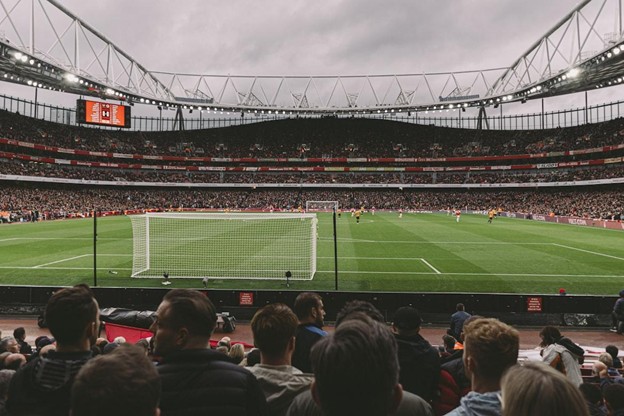
Arsenal’s Emirates Stadium – Source: Unsplash
There’s a certain kind of magic that descends each August when the Premier League curtain rises. On August 15th, the story begins anew, with Liverpool kicking off their title defence against Bournemouth at Anfield after romping to the crown last term. And after their dominance last season, coupled with the signings of Florian Wirtz, Jeremie Frimpong, and Hugo Ekitike, online betting sites make them the favorites to successfully claim the crown again this season.
The popular Bovada betting site currently has Liverpool listed as a 2.70 favorite for glory. They are expected to be challenged by both Arsenal and the formerly dominant Manchester City, who are priced at 3.25 and 4.25, respectively, by Bovada. Rather than worrying about a second straight title just yet, though, the Reds will be firmly focused on claiming three points in their season opener.
Over the course of the last decade, opening weekends have seen toppled goliaths, minted cult heroes, and rewritten scripts before most fans have had a chance to unpack their scarves. But what were the most shocking of them? Let’s take a look.
Arsenal 0–2 West Ham United (2015/16)
Heading into the 2015/16 season, the table was seemingly set for Arsenal. Petr Čech had arrived from Chelsea to signal fresh ambition, and the buzz around the Emirates was as loud as it had ever been throughout Arsene Wenger’s later years. They welcomed a youthful West Ham side, starting a 16-year-old Reece Oxford, and surely the hosts would walk away victorious.
Well, the illusion of superiority lasted all of forty-three minutes. A whipped-in Dmitri Payet free kick exposed the Gunners’ defensive frailties as Cheikhou Kouyaté rose to nod home, leaving the Emirates stunned into silence. Shortly after the break, a Mauro Zárate strike capitalized on more errant play from Arsenal’s back line—2-0, and old wounds ripped open once again.
Arsenal had 62% possession and 22 shots, but lacked penetration; West Ham, with just three shots on target, left with three points and their supporters in raptures.
Arsenal 3–4 Liverpool (2016/17)
A year later, another opening day at the Emirates. Two heavyweight attacks. And within minutes, the familiar Arsenal nerves—Theo Walcott’s missed penalty followed by a redemptive opener—gave way to Liverpool’s whirlwind. Philippe Coutinho’s bending free kick was just the spark. By the hour mark, the contest had devolved into dazzling mayhem: Adam Lallana sidestepping defenders, new signing Sadio Mané stamping his authority with an electric solo goal. Coutinho, again, punished a frail transition.
Arsenal’s late fightback—two quick goals from Alex Oxlade-Chamberlain and Callum Chambers—was pure adrenaline, but insufficient. Despite 53% possession, more chances, and nearly 600 passes, the Gunners’ defence wilted under Liverpool’s high-intensity pressing. The 4-3 final score was ruthless evidence that Klopp’s Liverpool were evolving into the league’s most unpredictable force.
Liverpool ended the weekend as headline-makers, and the Klopp era was officially underway, while Arsenal’s defensive statistics began a season-long decline.
Will Liverpool and Arsenal give us another classic match this morning?
— Bovada (@BovadaOfficial) October 27, 2024
Manchester United 1–2 Brighton & Hove Albion (2022/23)
United fans greeted Erik ten Hag’s reign with hope—a roster revamped, hunger rekindled. None of it survived an hour against a Brighton side drilled for precision by Graham Potter. If you want numbers, consider this: United boasted 63% possession and fired 17 shots; Brighton, statistically ruthless, claimed their opening goal after just 30 minutes, and doubled the lead six minutes later as Pascal Groß feasted on defensive lapses.
The second half was agony for the Stretford End, an Alexis Mac Allister own-goal offering faint hope. But the xG metric laid the ugly truth bare: United, for all their territorial dominance, created little of consequence. Brighton’s disciplined press forced 10 turnovers in the final third—the kind of data that signalled a new, quiet revolution.
The result was no fluke. Brighton’s European-style ball circulation and layered pressing became the season’s coaching case study. For United, the hangover lingered; it took months for tactical fluency to replace old habits—a journey that began, unmistakably, with this wake-up call.
Burnley 3–2 Chelsea (2017/18)
No fortress is more intimidating than Stamford Bridge on opening day—especially for a Burnley side priced at 15/1 to win against the reigning champions by the bookies. But Sean Dyche’s men tore up the script after Gary Cahill’s early red card left the champions wobbling. Burnley sprang forward with efficiency: Sam Vokes pounced twice, and Stephen Ward lashed home a left-foot rocket.
Chelsea, in a daze, clawed back with goals from new signing Alcaro Morata and David Luiz, yet the headlines had long been written. Burnley finished with just 37% possession but converted three of their four shots on target in a clinical display. Chelsea, meanwhile, became the first reigning champions in 23 years to ship three goals at home in a season opener.
The ripple effect? Burnley rode the momentum to their highest Premier League finish and a maiden trip into Europe. Chelsea scrambled for identity for months before ultimately finishing down in fifth, just two places higher than the Clarets.